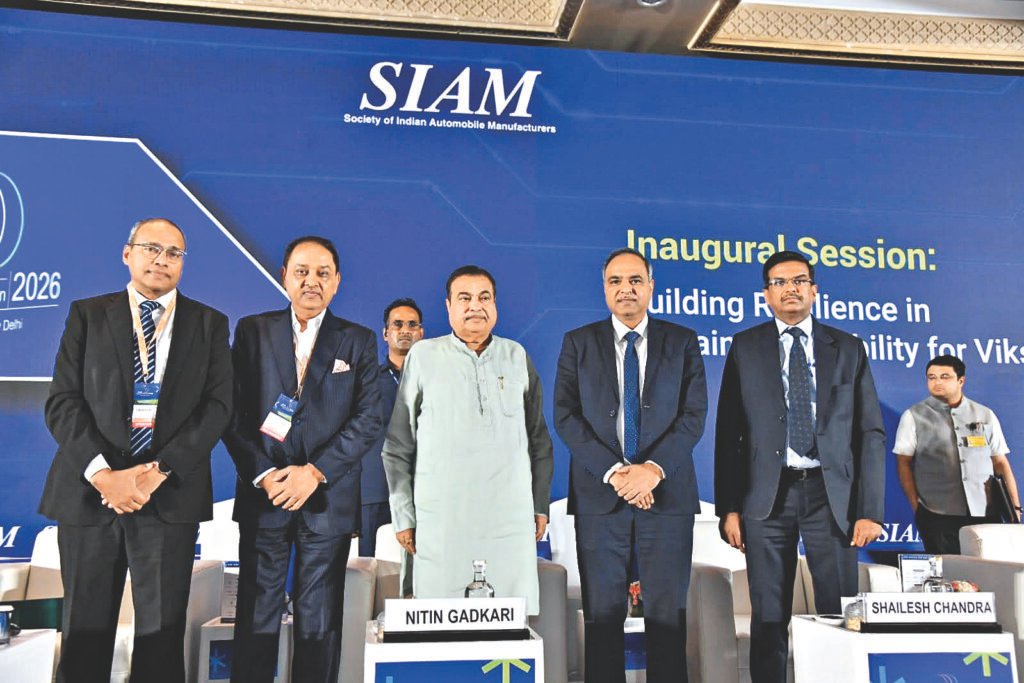


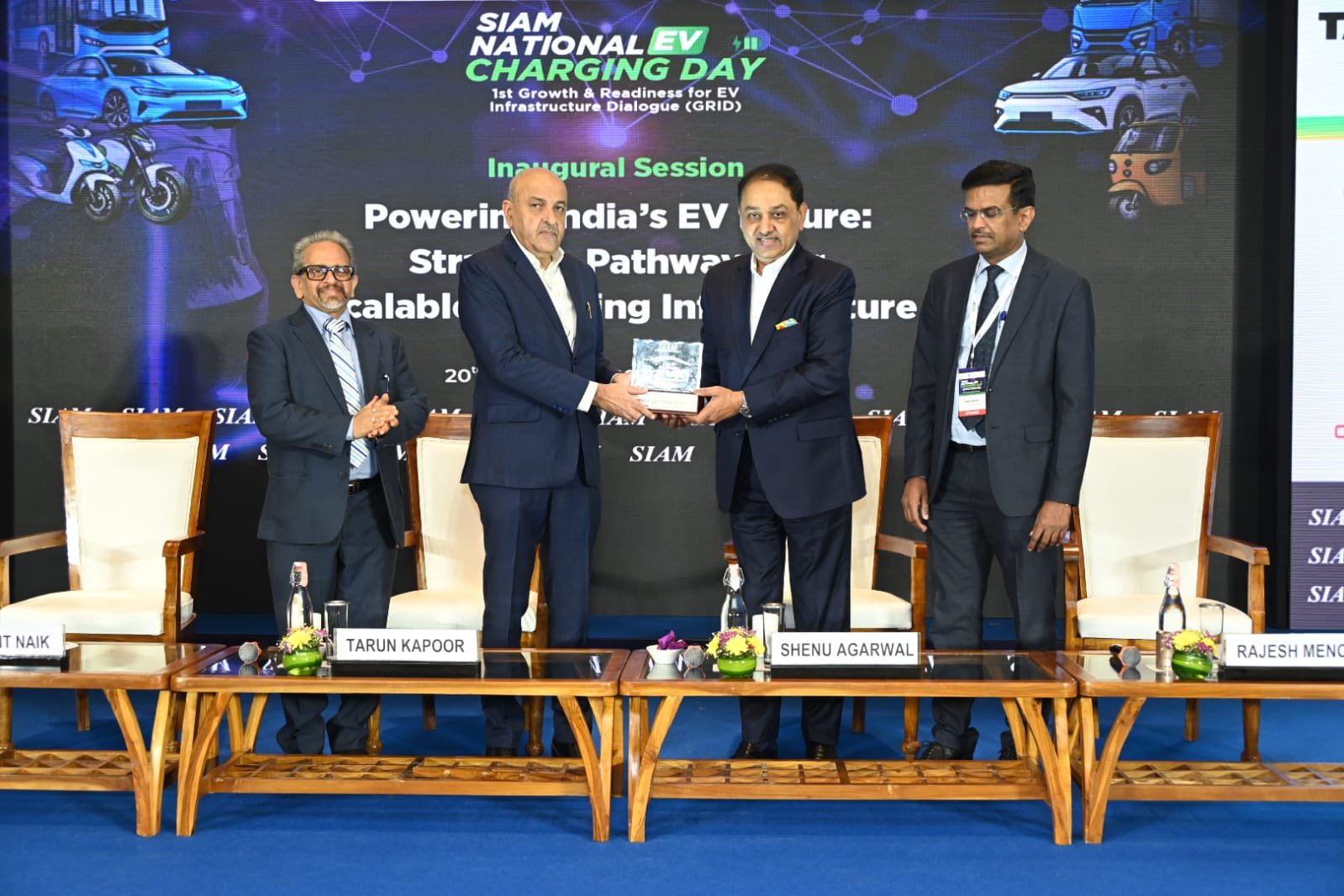
The Society of Indian Automobile Manufacturers (SIAM) with the support of Ministry of Heavy Industries, Government of India organised its first National EV Charging Day – 1st Growth & Readiness for EV Infrastructure Dialogue (GRID 2026) in New Delhi, under its Electrification initiative. With the theme ‘Powering India’s EV Future: Strategic Pathways for Scalable Charging Infrastructure’, the event brought together policymakers, senior government officials, state representatives and industry leaders who deliberated on strategies for accelerating the development of a robust, accessible and scalable electric vehicle (EV) charging ecosystem in India.
The dialogue commenced with an engaging inaugural session focused on how India can power its EV future and enhance charging capacity. The session also marked the launch of the SIAM National EV Charging Day logo. Key dignitaries shared valuable insights on what strategies should be adopted.
Chief Guest, H. D. Kumaraswamy, Hon’ble Union Minister, Ministry of Heavy Industries and Ministry of Steel, Government of India, congratulated the industry on launch of SIAM National EV Charging Day and said, “Accessible charging infrastructure is the backbone of electric mobility. We must be clear about how progress is measured. The number of charging stations sanctioned or installed is important, but it cannot be the only measure of success. A charging station must be operational, provide the required capacity, be easy to locate and access, and ensure convenient payments. Infrastructure that remains unavailable does not build confidence among users. Our ambition must extend beyond major metropolitan areas to smaller towns, rural areas, industrial districts, tourism circuits and emerging economic corridors. Let us work together to make India’s EV ecosystem accessible, reliable, inclusive and globally competitive.”
Guest of Honour, Tarun Kapoor, Advisor to Hon’ble Prime Minister of India, Govt. of India said, “The launch of SIAM National EV Charging Day marks an important step in recognising the growing significance of charging infrastructure in India’s electric mobility transition. As the charging network expands across the country, the focus must remain on reliability, regular maintenance and reasonable tariffs to encourage wider consumer adoption. This will require close collaboration among vehicle manufacturers, charging point operators, Oil Marketing Companies, distribution companies and other stakeholders, alongside infrastructure development for passenger and commercial vehicles, including electric trucks, three-wheelers and buses. Through sustained collaboration, innovation and appropriate policy interventions, India can build a robust, accessible and commercially sustainable EV charging network.”
Sushant Naik, Chairman, SIAM Electric Mobility Group and Global Head Govt. & Corporate Affairs, Chief Corporate Affairs Officer, Tata Motors Ltd., said, “India is at an exciting moment in the electrification journey of the mobility ecosystem. Electric mobility has moved from the margins to mainstream. The focus now must extend beyond EV adoption to charging infrastructure, which will accelerate the EV ecosystem. We are celebrating National EV Charging Day, which marks the beginning of a movement that will power India’s EV future. The opportunity for EV charging is huge, and with greater collaboration between industry, government and infrastructure players, we can build a robust, accessible and sustainable charging ecosystem that will drive India’s electric mobility journey forward.”
Shenu Agarwal, President, SIAM and Managing Director & CEO, Ashok Leyland Ltd., said, “India’s mobility story begins with India’s growth story. As the nation moves towards Viksit Bharat, every kilometre driven on a charging supply powered by a greener grid supports decarbonisation and energy security. EV adoption has moved from early adoption to mainstream momentum, with penetration rising from 0.7% in FY20 to 8.2% in FY26. Every new EV on the road creates a new charging need, so infrastructure must move in step with demand. India has the policy direction, clean power base and market momentum. The focus now must be on five key areas—Power, Space, Segments, Platform and Partnerships—to rapidly scale up a dependable charging ecosystem.”
In the second session, a fireside chat on ‘National Initiatives Powering India’s EV Charging Infrastructure’ focused on central government initiatives and policy measures to expand EV charging infrastructure. It was moderated by Mr. Prakash Rao, Co-Chair, SIAM Electric Mobility Group and Head Product Development: Powertrain, COEs & Facilities, Mahindra & Mahindra Ltd.
Guest of Honor, Dr. Hanif Qureshi, Additional Secretary, Ministry of Heavy Industries, Government of India, said, “The Ministry of Power guidelines stipulate that there should be a car charging station every 25 km on highways and a charging station for buses and trucks every 100 km. We are progressing towards achieving this, and the journey is becoming smoother. In the truck segment many vehicles are deployed in sectors such as mining, steel and ports. Charging infrastructure must also evolve to cater to these requirements as well, alongside strengthening the grid and distribution infrastructure. Charging infrastructure requires coordination between various levels of government, particularly state governments. Under the PM E-DRIVE scheme, about 9,000 chargers are being set up, and approximately ₹900 crore has been sanctioned to various state governments for charging infrastructure. Local bodies and private entities must also coordinate to organise land and connections. In most states, policies have helped in smoothening the journey of identifying sites and providing chargers, making the overall exercise of deploying charging infrastructure more seamless.”
Ravi Dhawan, Director, Ministry of Power, Government of India, said, “What used to be a bottleneck in the distribution sector is now gradually improving. We are transitioning towards better outcomes, and the number of outages and their duration have improved significantly over the last few years. There is continued emphasis on strengthening infrastructure and building the network capacity required at the local level. As electrification increases, distribution companies must prepare for emerging demand and strengthen their infrastructure to support it. The Government of India has recently sanctioned Viability Gap Funding for 92 GWh of energy storage capacity. This is expected to provide significant support to DISCOMs in managing their power requirements. AI-enabled solutions are also being developed to help distribution companies better utilise infrastructure, manage demand and shift peak loads.”
The third session, a State Leadership Panel Discussion themed ‘State-led Strategies for Accelerating EV Charging Deployment’, explored state-level initiatives, implementation challenges and practical solutions for expanding charging infrastructure across India. Moderated by Mr. Omkar Shaligram, Head – EV Charging and Ecosystem Development, Tata Motors, the discussion featured Dr. Nidhi Sarohe, Joint Commissioner (Transport), Government of NCT of Delhi, who shared insights into Delhi’s initiatives to expand EV charging infrastructure and improve accessibility for consumers; Mr. Ravinder Singh, IAS, CEO, UPREV, Uttar Pradesh, who emphasised charging network uptime and reliable consumer experiences; Mr. Sooraj E.M., Guidance Tamil Nadu, who shared perspectives on strengthening the state’s EV ecosystem; and Mr. Dennis Rajan, Sector Lead, KSEBL, Kerala, who discussed land-based solutions that could serve as examples for other states. Mr. Kulbhushan Kumar, Partner, Grant Thornton, also participated in the deliberations.
The fourth session, Leadership Panel Discussion on ‘Scaling Investments, Innovation and Partnerships for India’s Charging Infrastructure’ examined investment opportunities, technological innovation, emerging business models and industry partnerships required to build a scalable charging network. It was moderated by Mr. Ashim Sharma, Senior Partner, NRI India.
During the event, Mr. Rajesh Menon, Director General, SIAM; Mr. Atanu Ganguli, Executive Director (Technical), SIAM; Mr. Kartikey Hariyani, Founder & CEO, Chargezone; Mr. Akshit Bansal, Founder & CEO, Statiq; Mr. Virendra Goyal, Head – EV Charging, Tata Power; Mr. Sutripto De, General Manager and Head – New and Renewable Business, Bharat Heavy Electricals Ltd. (BHEL); Mr. Aravind Prasad, Head – Charging Infrastructure, Ather Energy; and Ms. Neha Jain, Head – Strategy, EV and Innovation, JSW MG Motor India, also shared their thoughts on how India can power its EV future and enhance charging capacity.
Through this dialogue, SIAM reinforced the importance of coordinated efforts among policymakers, state governments and industry stakeholders in developing an accessible, reliable and future-ready EV charging ecosystem to support India’s electric mobility ambitions.