

Daimler Truck’s IAA Transportation 2026 showcase revealed the EU CV industry is at a crossroads. The urgency of decarbonisation, the policy and infrastructure gap, industrial competitiveness, and the company’s expanding defence ambitions came to the fore and hold the answers for key markets like India, Ashish Bhatia writes.
Karin Rådström’s assessment at IAA Transportation in Hannover was striking in its simplicity. The CEO of Daimler Truck and Chairman of the ACEA Commercial Vehicle Board was not suggesting that the transition would be effortless, nor that the engineering challenges had disappeared. Her frustration lay elsewhere. The gap between what manufacturers can develop and what the wider ecosystem is equipped to adopt is striking. Trucking, she noted during our conversation, accounts for around seven per cent of global CO₂ emissions. For an industry with that environmental footprint, the opportunity to accelerate decarbonisation is significant. Yet the transition is not progressing at the pace she believes is possible. Charging infrastructure remains inadequate in key applications, energy availability and pricing complicate the operating equation, and customer demand is not scaling as quickly as anticipated. “I’ve been talking about this now for years,” she said, explaining why the tone of her message had become more forceful. What she wants is a more constructive dialogue between manufacturers, policymakers and the other players whose decisions determine whether low-emission transport can work at scale.
That frustration set the context for Daimler Truck’s appearance at IAA Transportation 2026. The company arrived with a broad portfolio of developments spanning battery-electric trucks, hydrogen fuel-cell technology, more efficient combustion engines, active safety, digital fleet management and defence mobility. The breadth of the display was deliberate. It reflected an organisation trying to advance the technology it believes transport will need while responding to the uneven pace of infrastructure development, regulation and customer adoption. For Rådström, the point is not to abandon ambition. It is to ensure that ambition translates into real-world outcomes.
Europe has historically played an influential role in setting the direction of commercial-vehicle technology. Successive Euro emissions standards required manufacturers to improve engines, emissions control and overall vehicle performance. The resulting pressure encouraged investment in engineering and helped European trucks establish strong positions in markets around the world. Rådström recognises the value of that history. In her view, regulation can be a powerful catalyst when it creates a clear direction for innovation and gives manufacturers a reason to develop better technology. Her concern is that policy is increasingly drifting away from that purpose. “It’s really dangerous when you have engineers working to solve bureaucratic problems that are not really making the trucks better,” she said. The risk, she argued, is that compliance requirements begin consuming engineering effort without producing proportional improvements in vehicles or transport outcomes. That, in turn, threatens the competitiveness of manufacturers.
The criticism is particularly relevant to the European Union’s heavy-duty vehicle CO₂ targets for 2030. Daimler Truck has argued that ambitious reduction targets must be matched by the charging infrastructure, energy supply and customer economics required to deploy zero-emission trucks. Without those conditions, manufacturers face the prospect of penalties even when demand and infrastructure are not developing at the necessary pace. The company’s position should be understood in that context. Daimler Truck is not arguing that decarbonisation should be postponed indefinitely. It is challenging the assumption that vehicle technology alone can deliver the transition. A truck can be engineered, tested and placed on sale, but its adoption depends on whether an operator can charge it, use it on the required route, carry a commercially viable load and recover the investment.
During our interaction, Rådström made an unusually candid observation about the electric-truck business, “We overinvested, you could say.” She was referring to the mismatch between the investment made in electric trucks and the infrastructure and market volumes available to support them, not to a claim that the vehicles themselves were technically inadequate. The trucks, she said, are not the problem. The infrastructure is not yet in place, and the volumes are not building as quickly as the business case anticipated. Manufacturers are developing technologies that can reduce emissions in suitable applications, but the commercial conditions required for adoption are not keeping pace. If regulation continues to assume a faster transition than the market can support, the industry risks being penalised for a gap that it cannot close by itself. This is the central tension behind Daimler Fast Forward.
Daimler Truck’s electric portfolio suggests that battery-electric transport has moved beyond a single-product experiment. The Mercedes-Benz eActros 600, which entered series production and customer operations in late 2024, has accumulated more than 160 million kilometres in customer use, according to the company’s IAA 2026 announcement. Daimler Truck also reported that Mercedes-Benz Trucks held around 38 per cent of the European medium- and heavy-duty market for locally CO₂-free trucks in the first half of 2026. These figures provide evidence of progress, although neither automatically establishes that electric trucks are viable for every application. The commercial case remains dependent on duty cycle, charging access, energy prices, payload and operating patterns. The eActros 600 offers a range of up to 560 kilometres in its most energy-efficient configuration at a Gross Combination Weight (GCW) of 40 tonnes. The more significant development at Hannover, however, was the public debut of the eActros Lowliner, which broadened the electric portfolio into high-volume transport.
Lowliner tractor units are designed to operate with trailers that offer increased interior volume. They are particularly useful when the limiting factor is cargo space rather than payload mass. Bringing battery-electric technology into this segment is important because freight operators do not all move the same kind of load or follow identical routes. The eActros Lowlineris based on the eActros 600’s overall technological concept and is designed to match the coupling height and ground clearance of comparable diesel trucks. The arrangement enables the use of mega trailers with interior heights of up to three metres while helping fleets integrate the electric vehicle into existing operations. Daimler Truck announced availability for orders in EU30 markets and additional international markets from the third quarter of 2026, with series production scheduled at Wörth for the second quarter of 2027. Yet Rådström’s point remains relevant. More applications create opportunities for adoption, but they do not remove the need for accessible, reliable and competitively priced charging. The infrastructure question becomes more urgent as the vehicle range expands.
HYDROGEN RETAINS ITS PLACE
Battery-electric technology is only one part of Daimler Truck’s decarbonisation roadmap. Hydrogen fuel-cell trucks remain a parallel development path, particularly for applications where the company sees advantages in operating range and refuelling requirements. The NextGenH2 Truck made its public debut at IAA Transportation. Building on the development and testing of earlier fuel-cell prototypes, the new generation adopts several components and systems from the battery-electric eActros 600, including the integrated electric axle, ProCabin, Multimedia Cockpit Interactive 2 and the latest safety assistance technologies.
Daimler Truck plans a small series of 100 NextGenH2 trucks, with customer operations scheduled to begin from the end of 2026. The company reported that its existing fuel-cell trucks had already accumulated almost 600,000 kilometres in customer trials, and that nearly 50 vehicles for the next customer-trial programme were already assigned. Dachser is set to become the first logistics service provider to deploy the NextGenH2 Truck. The development is notable for its move towards customer operation rather than remaining solely within a laboratory or prototype programme. Operating experience can help establish how the technology performs under commercial conditions and what infrastructure, service and operational support customers will require. However, hydrogen introduces its own ecosystem challenges. The availability and cost of the fuel, refuelling infrastructure, energy supply and total cost of ownership will shape adoption. It would be premature to treat it as a universal answer, just as it would be unrealistic to assume battery-electric technology will suit every transport task. The strategic implication is that Daimler Truck is continuing to develop more than one route to lower-emission transport, with deployment shaped by the requirements of individual applications.
THE CONVENTIONAL POWERSTRAINS
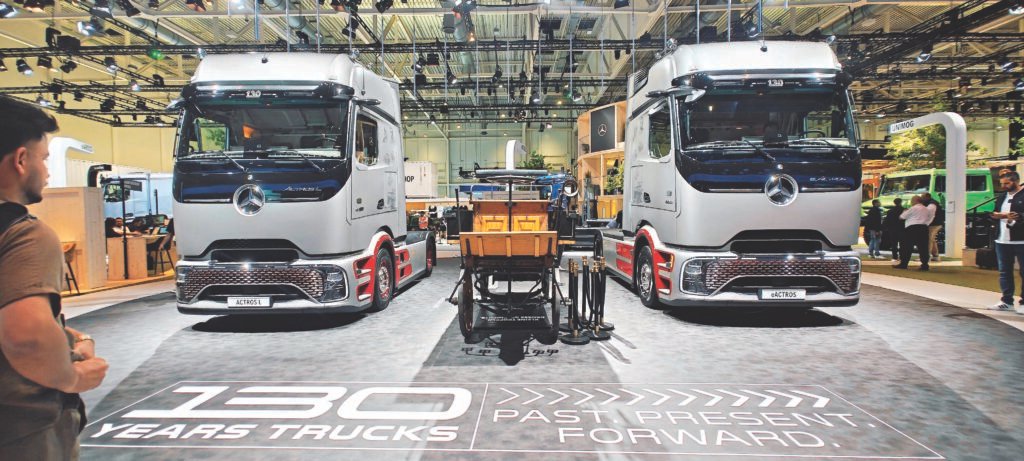
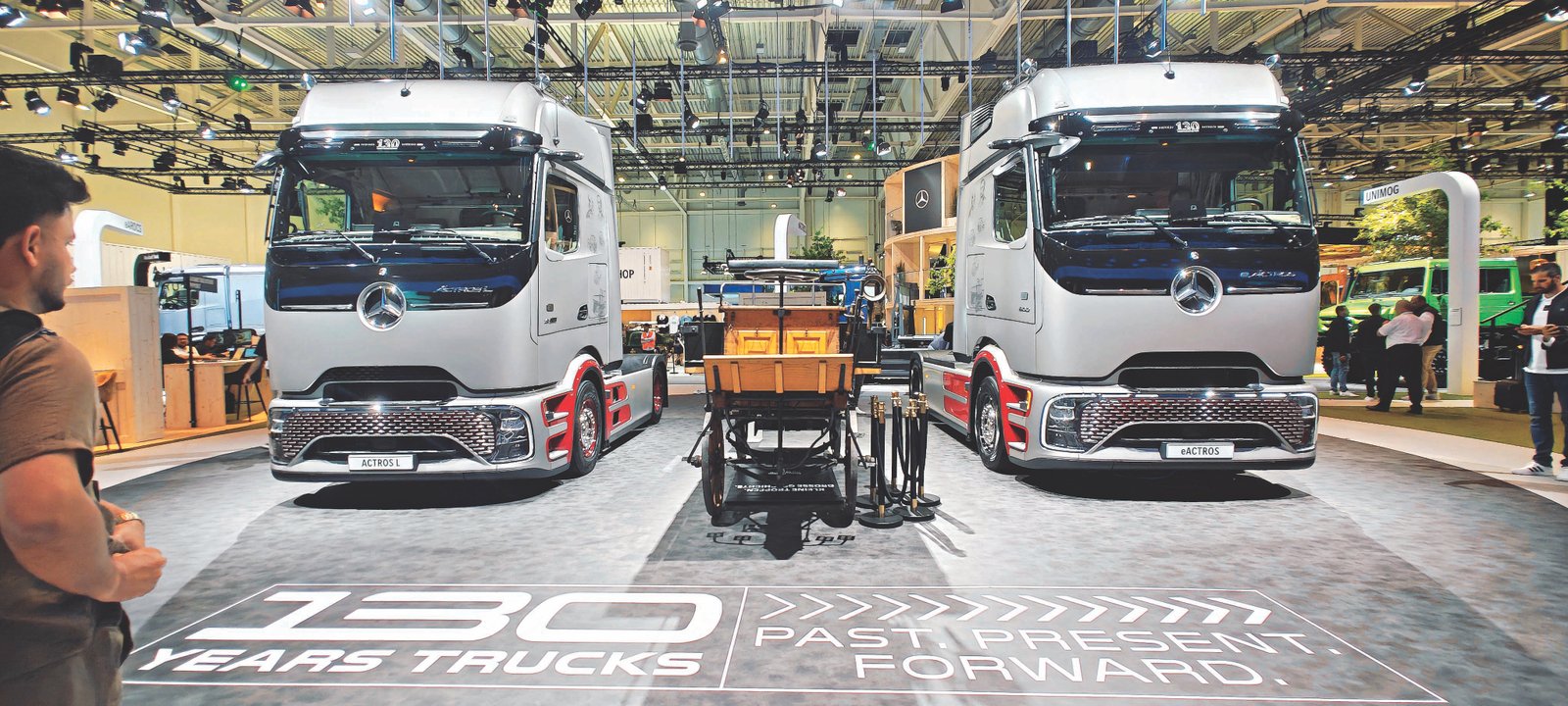
For many operators, diesel remains the most practical option because of established infrastructure, predictable refuelling and the operating economics of existing fleets. Daimler Truck’s new Powerliner driveline generation, presented at IAA Transportation, illustrates the continuing effort to improve combustion-engine efficiency. The package combines enhanced OM 470 and OM 471 engines with coordinated transmissions and axles. The company states that it can deliver up to four per cent lower fuel consumption than a similarly specified predecessor vehicle, alongside increased power and torque and improved drivability. The 130 Years Trucks Edition made the same point visually. Limited to 400 vehicles worldwide, the anniversary series is based on the Actros L or the battery-electric eActros 600. For the first time, Mercedes-Benz Trucks is offering a special edition of this kind with both diesel and battery-electric powertrains. The anniversary vehicle joins historical design elements with the contemporary ProCabin, connecting the company’s long commercial-vehicle history with its current engineering priorities. More importantly, it underlines the range of technologies that the company expects to serve customers during the coming transition.
SAFTEY AND DIGITALISATION ARE PART OF THE TRANSFORMATION
Daimler Truck also presented new and enhanced assistance systems designed to support drivers in demanding traffic situations. Active Cross Traffic Assist can help drivers when the system detects a risk of collision with crossing vehicles or motorcycles. Active Sideguard Assist 3 expands turning-assistance support to both sides of the vehicle, including a function for turns across the driver’s side with automated braking support under specified conditions. The enhanced Active Drive Assist 3 introduces further refinements to assisted driving, while Attention Assist 2 uses camera-based monitoring to detect signs of distraction or fatigue.
The digital offering is evolving at the same time. Daimler Truck is reorganising Fleetboard into a more coherent portfolio covering fleet management, analytics, compliance, charging management and proactive diagnostics. The My TruckPoint Store is intended to make selected digital services easier to discover and book, while developments in TruckLive and vehicle-data services connect vehicles more closely with fleet operation
DEFENCE IN A CHANGED WORLD
One of the most consequential announcements around IAA Transportation was not about commercial freight at all. Daimler Truck has established Daimler Truck Defence as a new global brand, consolidating defence activities and creating a more unified international presence for the business. The company plans to invest a mid-three-digit-million-euro amount over the coming years to expand development, production, sales and service capabilities. It has set a target of generating Euro one billion in defence-related revenue by 2028. The strategy envisages expanding the offering beyond Mercedes-Benz Special Trucks to include additional vehicle portfolios and brands from across Daimler Truck. The announcement reflects a changing security environment and the demand for reliable military mobility and logistics. Daimler Truck’s existing production network, engineering expertise, vehicle platforms and service capability offer an industrial foundation on which to build a larger defence business. During our interaction, Rådströmacknowledged the uncomfortable reality behind this expansion: nobody wants war, but the situation unfolding around the world creates a requirement to which industrial businesses must respond. India’s growing relevance
Rådström’s comments on India offered another important perspective on how the company intends to use its capabilities. She said one of the early organisational changes under her leadership was to integrate BharatBenz more closely with Mercedes-Benz Trucks, in part to make better use of India for global purposes. The Indian operation already contributes beyond domestic vehicle production. Bengaluru supports global software, research and development and aftersales processes. Rådström also sees further potential to use Chennai for components and global sourcing, pointing to the improvement in the capabilities of Indian suppliers over the past decade. Rådström welcomed signs of movement in India on hydrogen and electric mobility, but returned to the lesson she drew from Europe. Infrastructure should be developed early enough to support scaling, rather than waiting until vehicles are ready and customers are demanding them.
Watch out for exclusive conversations with Achim Puchert and Torsten Schmidt, exploring Daimler Truck’s global ambitions.
WHEN BUREAUCRACY RISKS COMPETITIVENESS
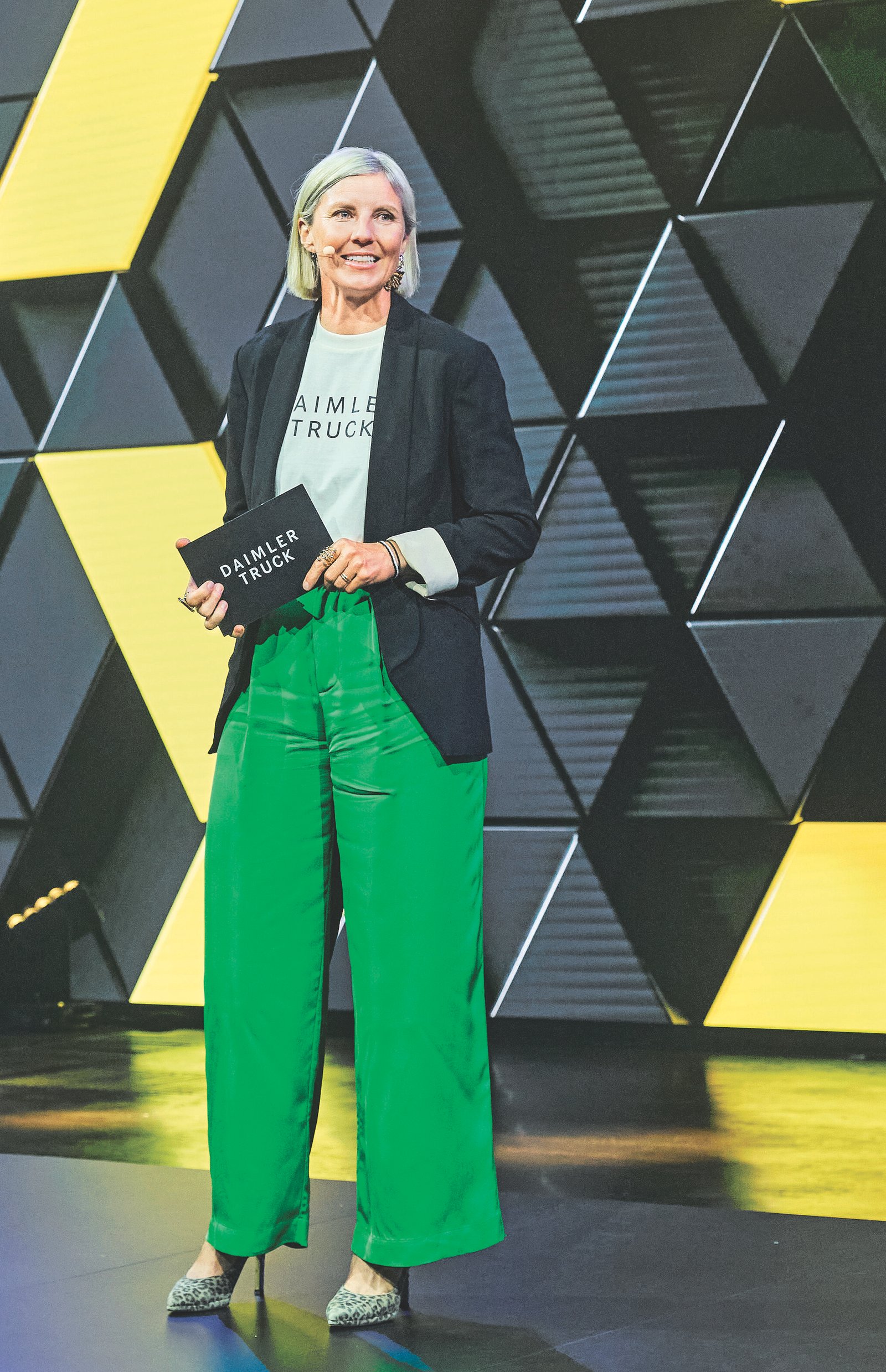
Karin Rådström, CEO of Daimler Truck and Chairman of the ACEA Commercial Vehicle Board on accelerating decarbonisation, the disconnect between technology and infrastructure, Europe’s regulatory approach, and India’s growing contribution to the global organisation in this conversation with Ashish Bhatia.
Q. You have been increasingly vocal about the pace of decarbonisation. What is driving that urgency, and where do you see the biggest gap between ambition and reality?
A. I think we have a unique opportunity in this industry. It is technically not that difficult to decarbonise trucking, and trucking accounts for around seven per cent of global CO₂ emissions. Sometimes, I get frustrated because it would be possible to decarbonise, but the transition is moving too slowly. It feels as though not all the players are really on board to make it happen. That is one of the reasons I decided to stay in this industry. I want to be part of driving that change. It is also something that motivates many people in our company. I have been talking about this for years, but I do not feel that it is gaining enough traction. So we have raised the tone a little, hopefully to encourage more constructive dialogue and better solutions, particularly when it comes to charging infrastructure.
Q. You have highlighted the responsibility of policymakers. Where is the current approach falling short?
A. Historically, Europe had a very positive role on the policy side. The successive Euro 3, Euro 4, Euro 5 and Euro 6 standards pushed manufacturers and our competitors to keep improving technology. That was a positive development, and it is one reason European trucks are now leaders in many markets around the world. But I think we have reached a point where there is a little too much policy that is not necessarily driving technological innovation. Increasingly, it is moving in the direction of bureaucracy. That is dangerous when engineers are working to solve bureaucratic problems that are not making the trucks better. It risks our competitiveness. When regulation genuinely challenges us to develop better technology, it can be a powerful driver of progress. The concern is when the demands become disconnected from the improvements that the industry is capable of delivering.
Q. Daimler Truck has already invested significantly in electric trucks. Why is adoption not progressing at the pace you anticipated?
A. When it comes to electrification, I think it was good that the CO₂ regulation came into place early. It encouraged us to develop electric trucks, and we invested heavily in that technology. The trucks themselves are fantastic. The problem is that we do not have the infrastructure in place, and the volumes are not really coming up. We have, in a sense, overinvested relative to the conditions in the market. But more importantly, the current situation is not driving the shift to sustainable, CO₂-free transport at the speed we want. That is frustrating, because the ultimate objective is to make that transition happen. We need to bring the different elements together. Manufacturers can develop the vehicles, but charging infrastructure and the conditions for customers to use them commercially are also essential. Without these, it becomes difficult to scale adoption.
Q. Does that mean the industry needs a different approach to regulation and the transition?
A. I think we need constructive dialogue and better solutions, rather than simply adding more requirements. We have to ensure that policy supports technological innovation and that the ecosystem develops alongside the vehicles. The experience with emissions standards in Europe shows that regulation can push an industry forward. But we must make sure that it continues to do so, rather than creating bureaucracy that does not improve the product or the outcome. The challenge is to align what manufacturers are developing with what the wider market can support. The objective should remain the transition to sustainable transport, and we need to make sure that the conditions are in place to achieve it.
Q. Turning to India, what role do you see the country playing in Daimler Truck’s global strategy?
A. One of the first changes we made when I became CEO was to integrate BharatBenz more closely with Mercedes-Benz Trucks. One of the reasons for doing that was to enable us to leverage India even better for global purposes. We have a research and development hub in Bengaluru, where we undertake global software work, support a number of aftersales processes and carry out development activities. That is an area we are looking to expand. With BharatBenz and Mercedes-Benz Trucks more closely integrated, I also think we can leverage Chennai better. We can build some components for global applications from Chennai, and we are already seeing more sourcing coming out of India. The capabilities of the Indian supplier base have improved considerably over the past decade. That gives us an opportunity to draw more on these capabilities in the future.
Q. What should India’s policymakers prioritise as the country advances electric and hydrogen mobility?
A. I know there is movement in India on both hydrogen and electric mobility, and I find that very positive. I think it is important to look at the lessons from Europe, particularly the need to start building infrastructure early. Infrastructure is going to be a challenge in India as well, and the important thing is to ensure that it is in place when we start scaling the vehicles. That would be fantastic. If we get the infrastructure ready as the market develops, we will be in a much better position to support adoption.